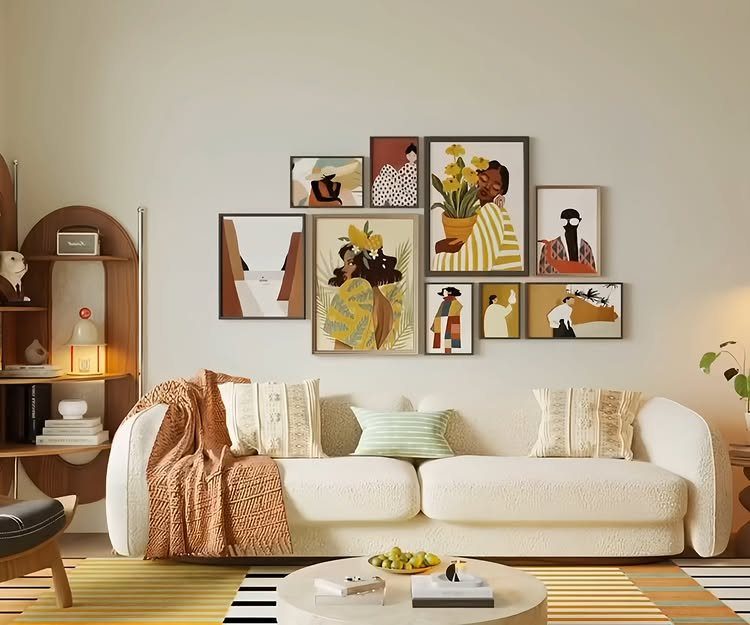
The right approach depends on the sofa’s length: a single piece works on compact sofas, while wider ones call for multiple frames or a collected arrangement.
Diptychs and triptychs land in the middle for effort, giving you a finished look without measuring out a dozen spacing intervals.
Once a piece crosses 20 pounds, you’re hunting for studs or installing anchors, so the frame’s heft shapes the install as much as the image does.
1. Proper Hanging Height
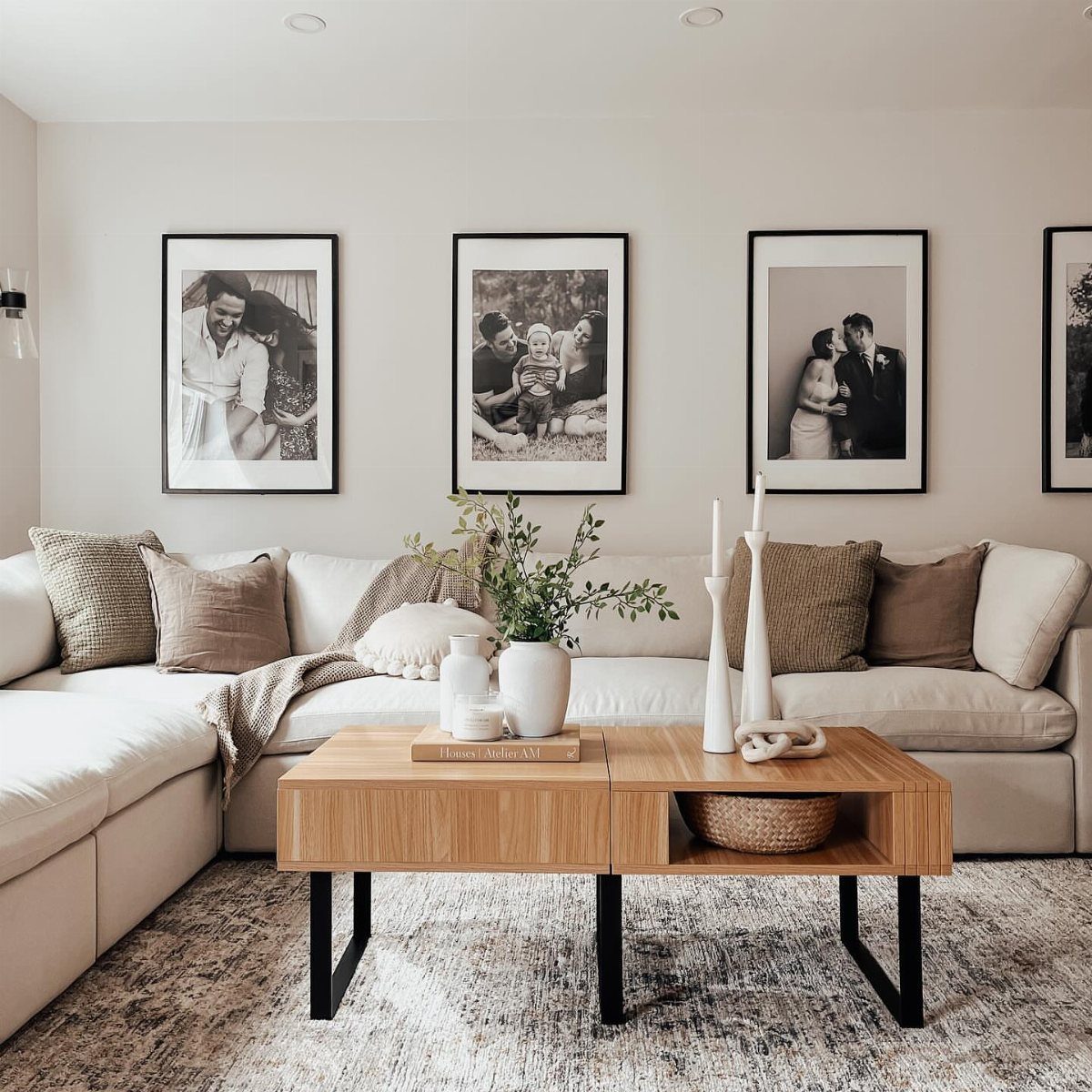
Closer than that and the art looks crowded by the cushions; higher and it floats away from the furniture.
Mark the sofa back’s top on the wall with painter’s tape, then measure up. With a row of three frames like these, hang them all at the same height so the line reads as one unit.
A low-profile sectional sits lower than most sofas, so aim for the middle of that range.
2. Metal Frames for Modern Looks
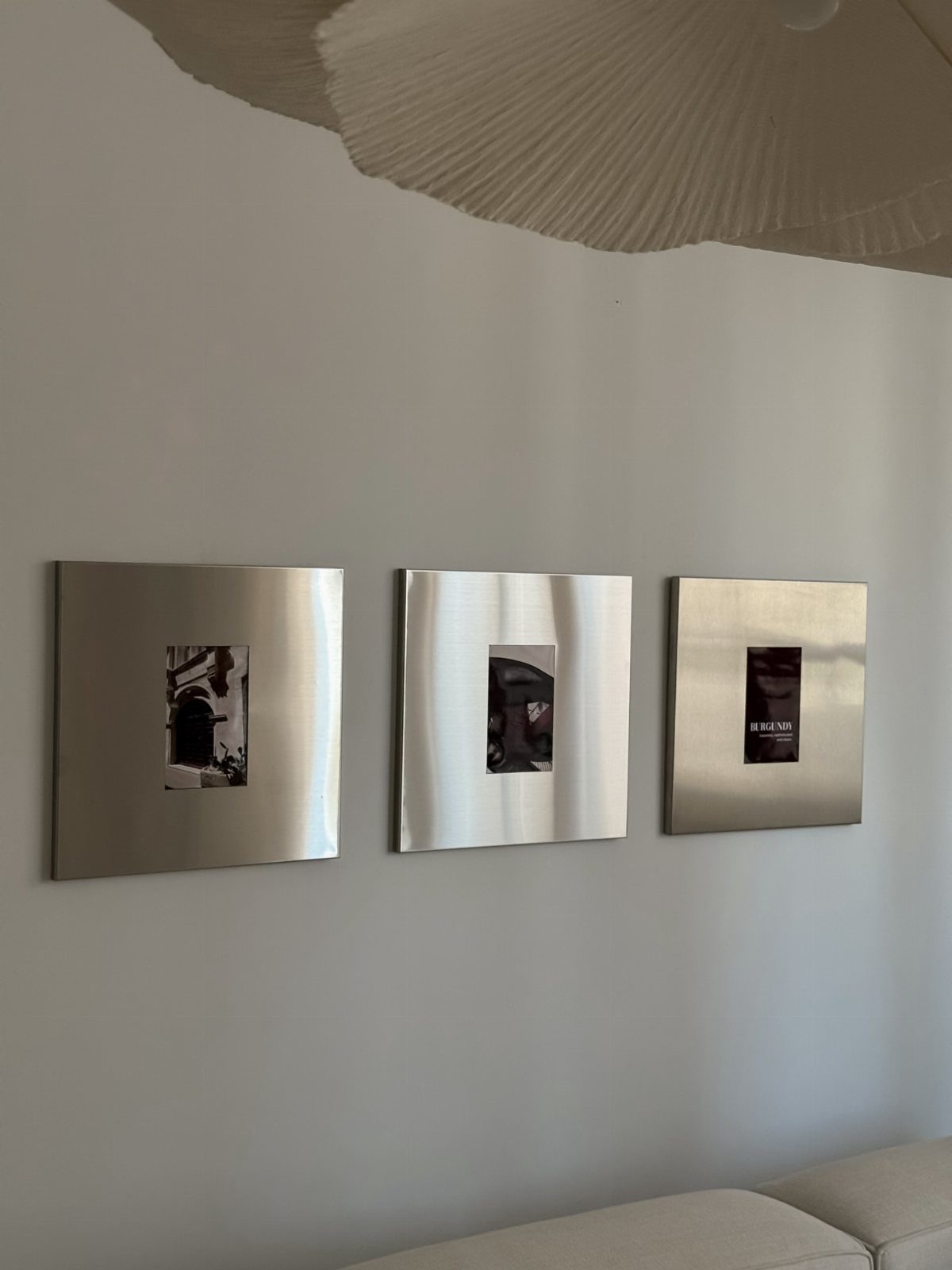
Brushed metal frames keep a wall quiet, and I like them best around small photos, where a thin profile lets the image carry the look.
Choose a finish that echoes something already in the room, such as a light fixture, so the frames feel chosen rather than added.
Square frames in a matched set of three read tidy over a light couch. Keep the spacing between them equal, and hang them level with each other.
A thin metal edge suits modern rooms. In a traditional room, wood may fit better.
3. Two-Thirds Rule
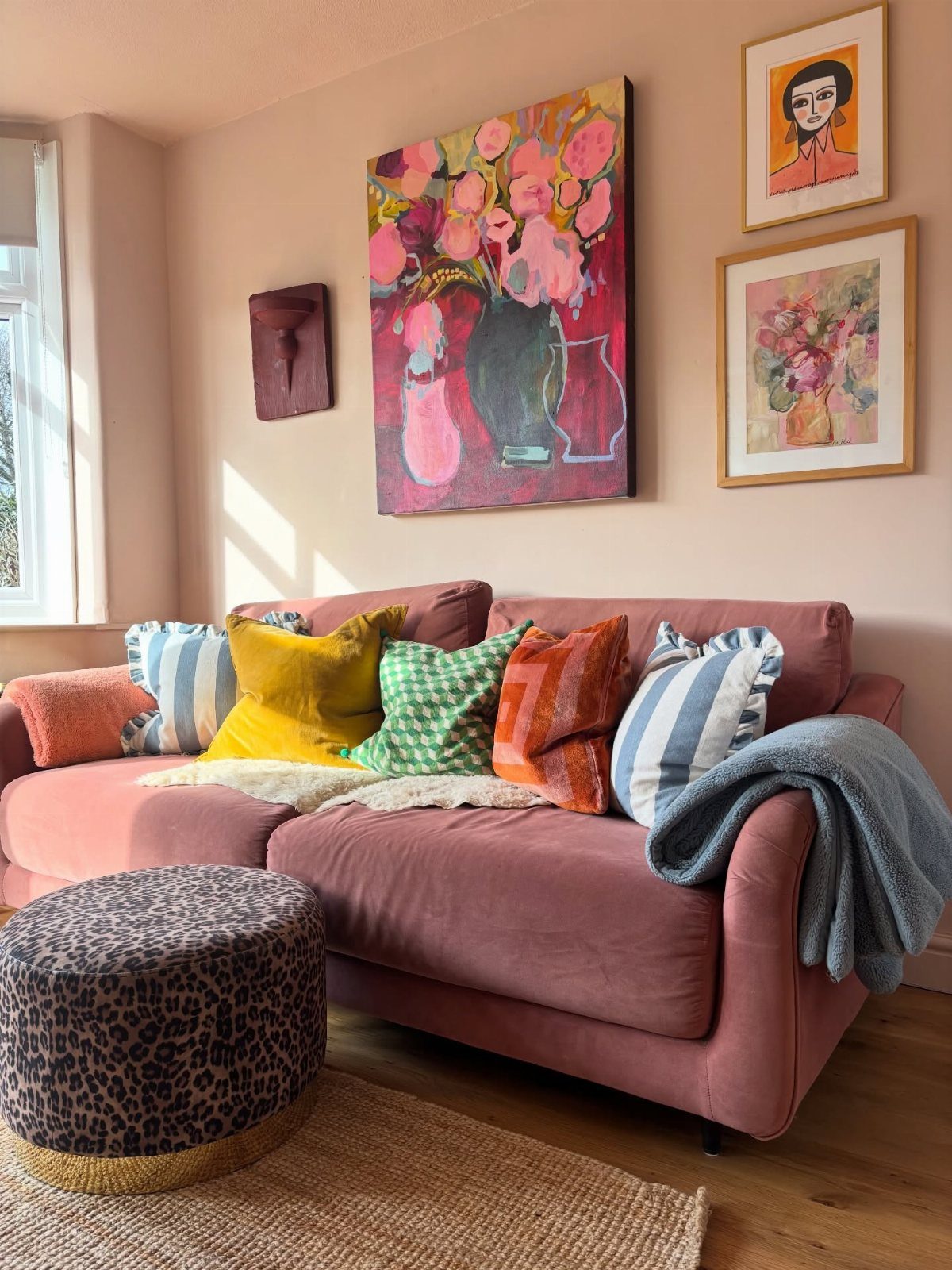
Size the art so it spans two-thirds of the sofa’s width.
A single large canvas gets there fast. A big painting with 2 smaller pieces beside it also works, as long as the whole group adds up to that width.
Before drilling, cut kraft paper to the target size and tape it up. Live with it for a day and you will know if it feels right.
4. Gallery Wall
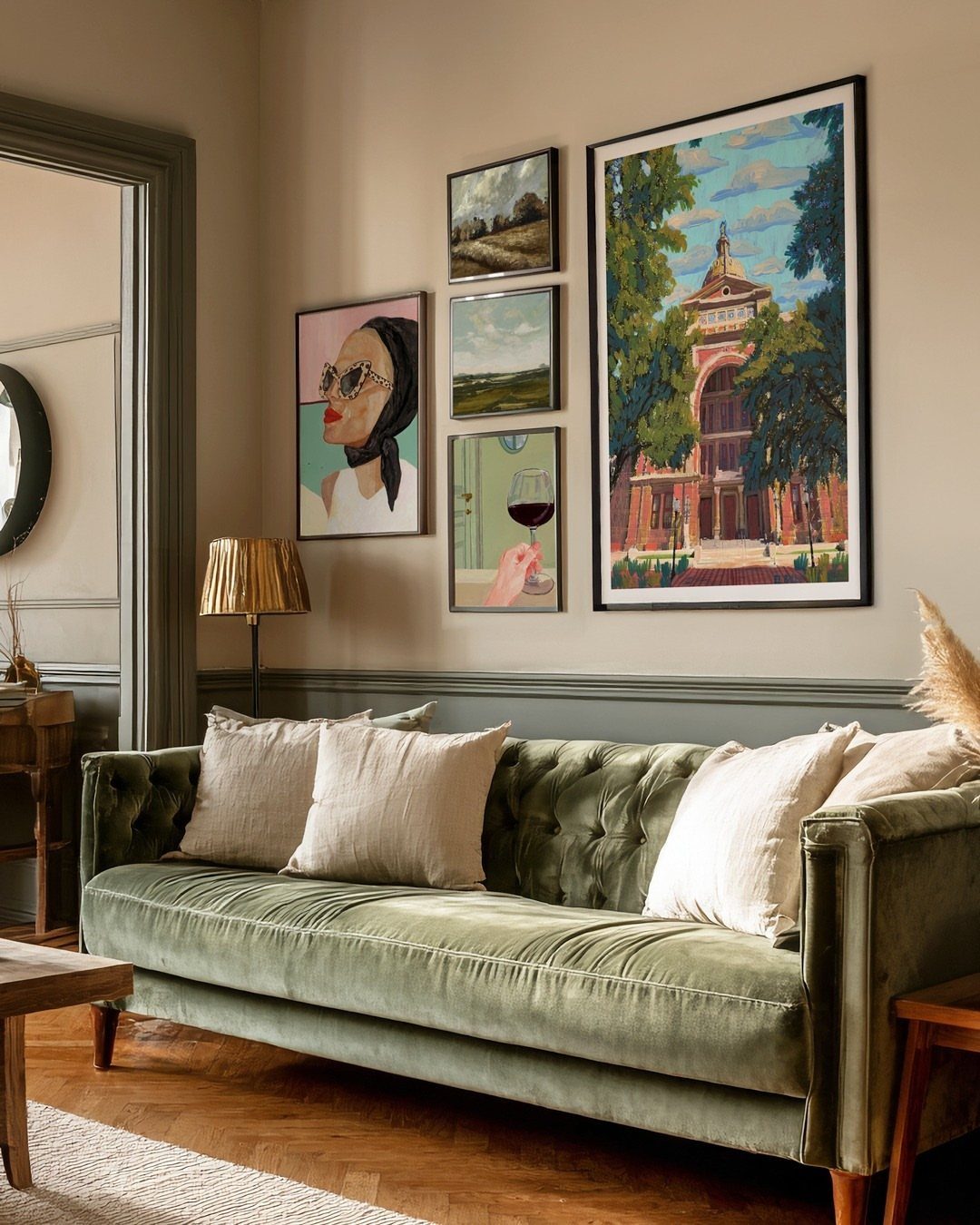
A handful of frames can look planned or scattered, and spacing is what decides it. Keep the gaps between frames consistent, and center the whole group over the sofa rather than centering each piece.
I cut paper templates for each frame and tape them up before I touch a nail. Shuffle them until the arrangement works, then drive nails through the paper.
Mix frame sizes, but repeat one color or material so the group holds together. Gallery walls take more planning than a single piece, but they are the most flexible option here.
5. Side-by-Side Art Prints
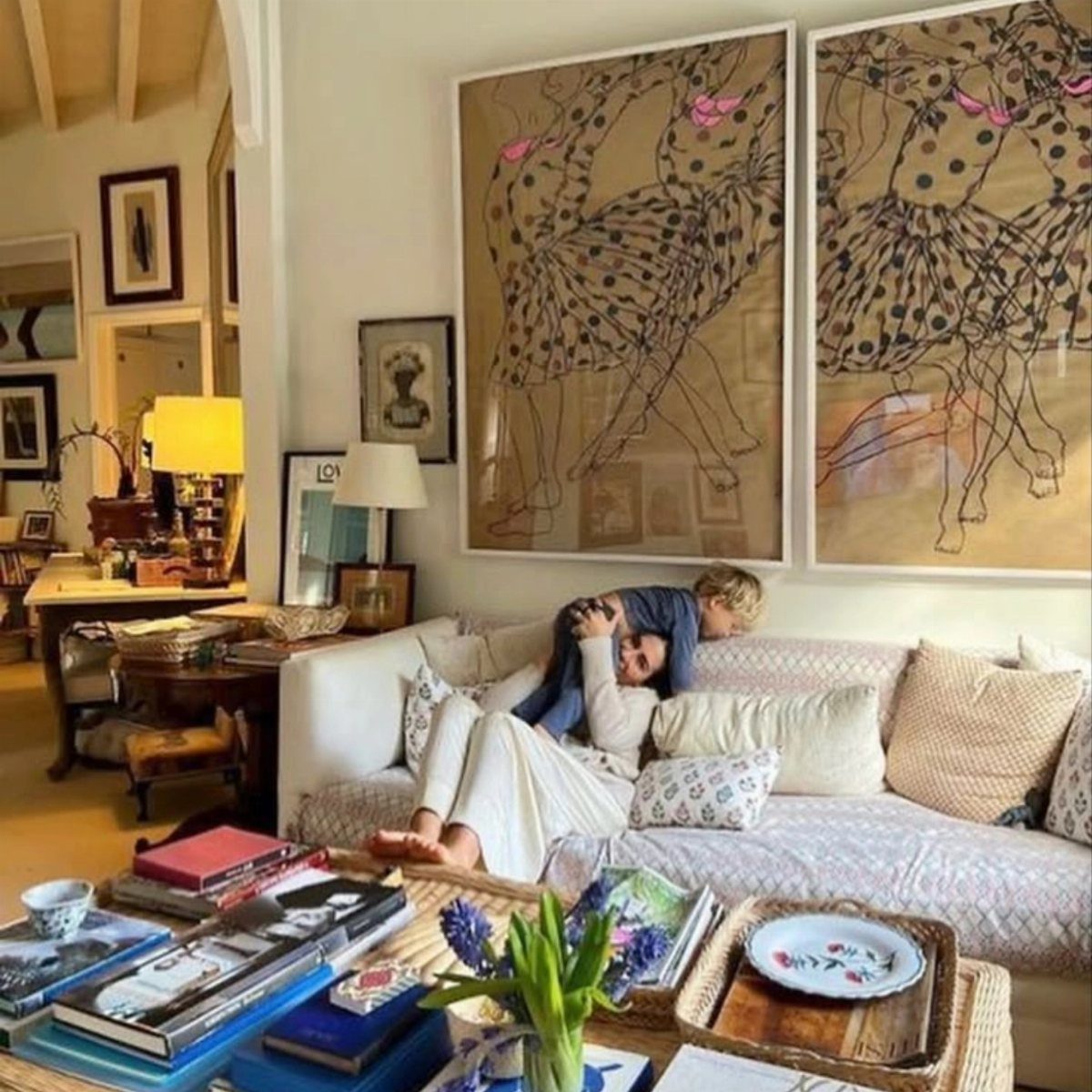
Two large matching prints hung side by side make a wide, calm statement, and the pairing means you decide only once on style and frame. Matching frames are the whole effect, so buy them together.
Hang them horizontally with a narrow, even gap between them, and treat the pair as one piece when you measure: center the pair, not each print, over the couch.
Large prints cost more than small ones, but 2 pieces are cheaper to hang than a full gallery wall.
Personal Touches in Art
Personal art earns its spot over a sofa when it has a reason to be there.
A painting you finished yourself or a set of your own framed prints carries more weight than anything chosen to coordinate with a throw pillow.
Mixing media keeps a wall from feeling flat. Photos, paintings, and textiles can share one display, and a woven hanging or vintage textile adds the texture that glass and paper lack.
Small sculptures or wall-mounted objects work too, as long as they are light enough for the wall. Travel finds and vintage pieces fit best in a layered, eclectic room.
If a piece means something to you, it belongs there, conventional or not. If a piece makes you smile every time you sit down, it belongs there.
Technical Hanging Tips
Trace each frame on kraft paper and tape the templates up before you make a single hole.
A laser level is worth buying if you hang more than one piece, because even a slight tilt is easy to spot over a sofa.
Match the hardware to the weight of the artwork, and read the rating on the package. Picture hanging kits usually include hooks, nails, and wire, so you get everything in one box.
Anything over 20 pounds needs a stud or a toggle anchor rated for the weight. If you can’t hit one, use a wall anchor, which matters most on bare drywall.
Renters or anyone who swaps art often can use picture hanging strips. Ask a friend to stand back and check alignment while you hold the frame.
Room Functionality Considerations
Walk past the wall in morning light and again in the evening to see where glare lands.
If the room gets a lot of natural light, reflection and glare can wash out a framed piece, and non-glare glass reduces the problem.
Keep the bottom edge high enough that nobody hits their head standing up from the couch. Frames with sharp corners deserve extra care near a seat.
Room layout changes the best placement.
In an open-concept space, hang art a bit higher so it stays visible from the next room. In a media room, where the sofa faces the TV, higher also works because the viewing angle is different.
For gaps between frames, a formal, conversation-style living room suits 2–3 inches. In a small room where the furniture sits low, I space frames 5–6 inches apart so the arrangement fills more vertical space without looking scattered.
Frequently Asked Questions
How high should artwork be above a sofa?
Leave roughly 4–10 inches between the top of the sofa back and the bottom edge of the art.
What is the 2/3 rule for sofas?
Art over a sofa should span about two-thirds of the sofa’s width.
A 90-inch couch, for example, calls for art around 60 inches wide. Cutting kraft paper to size and taping it up for a day shows whether the scale feels right.
What is the 2/3 rule for hanging pictures?
The two-thirds rule sizes the art to about two-thirds of the furniture’s width beneath it, which over a sofa keeps the wall from looking too sparse or too heavy.
It applies to a single piece or to a group of frames measured as one.
Where not to hang pictures?
Avoid spots where glare washes out the frame, so check the wall in morning and evening light first; non-glare glass helps if the room is bright.
Also skip hanging heavy art on bare drywall without a stud or a rated anchor.
Can art be too large for over the sofa?
Rarely. Oversized art can add drama in a contemporary room, and a large gallery-style group can even run wider than the sofa, which helps tie in a long wall.





