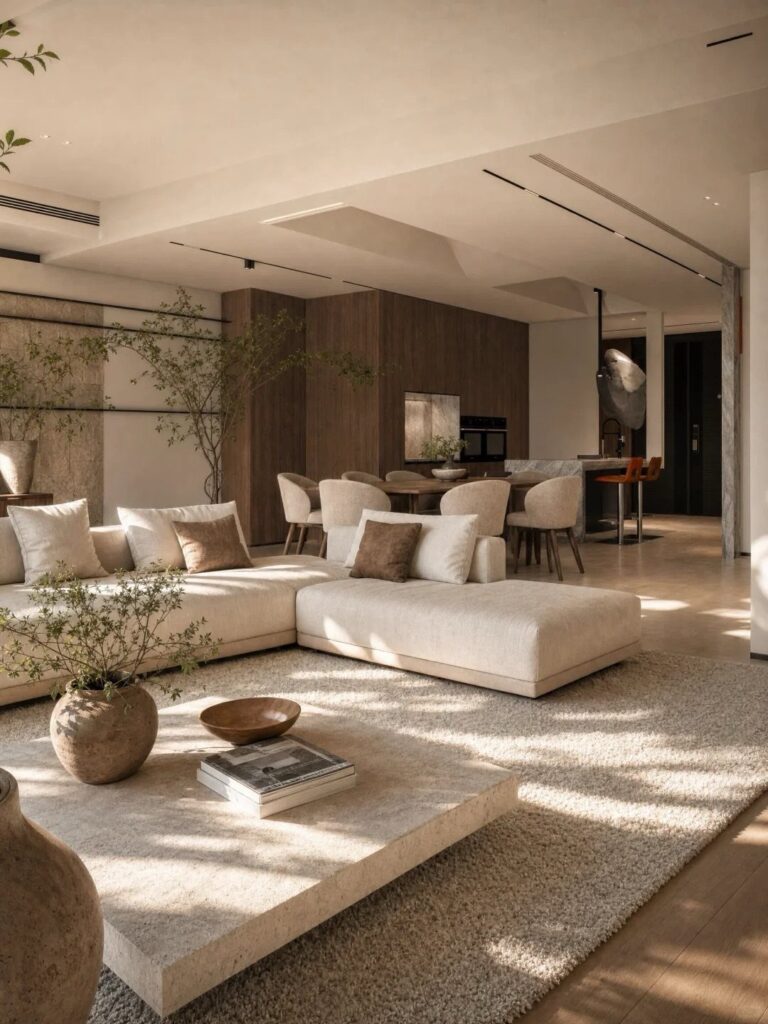
Ideas here run from swapping a table lamp for a stone floor lamp to installing live-edge floating shelves, and from a weekend hanging a wavy mirror to textured wall treatments that cost real money.
What picks yours is how much of the room you can change: renters can lean a wavy floor mirror, swap bulbs for warm lighting and add earthy accents, while owners can mount floating shelves into studs or finish a wall with texture.
Whatever the budget, the 70/30 split of clean, modern pieces to raw, textured ones keeps the room from turning heavy.
1. Neutral Color Palette
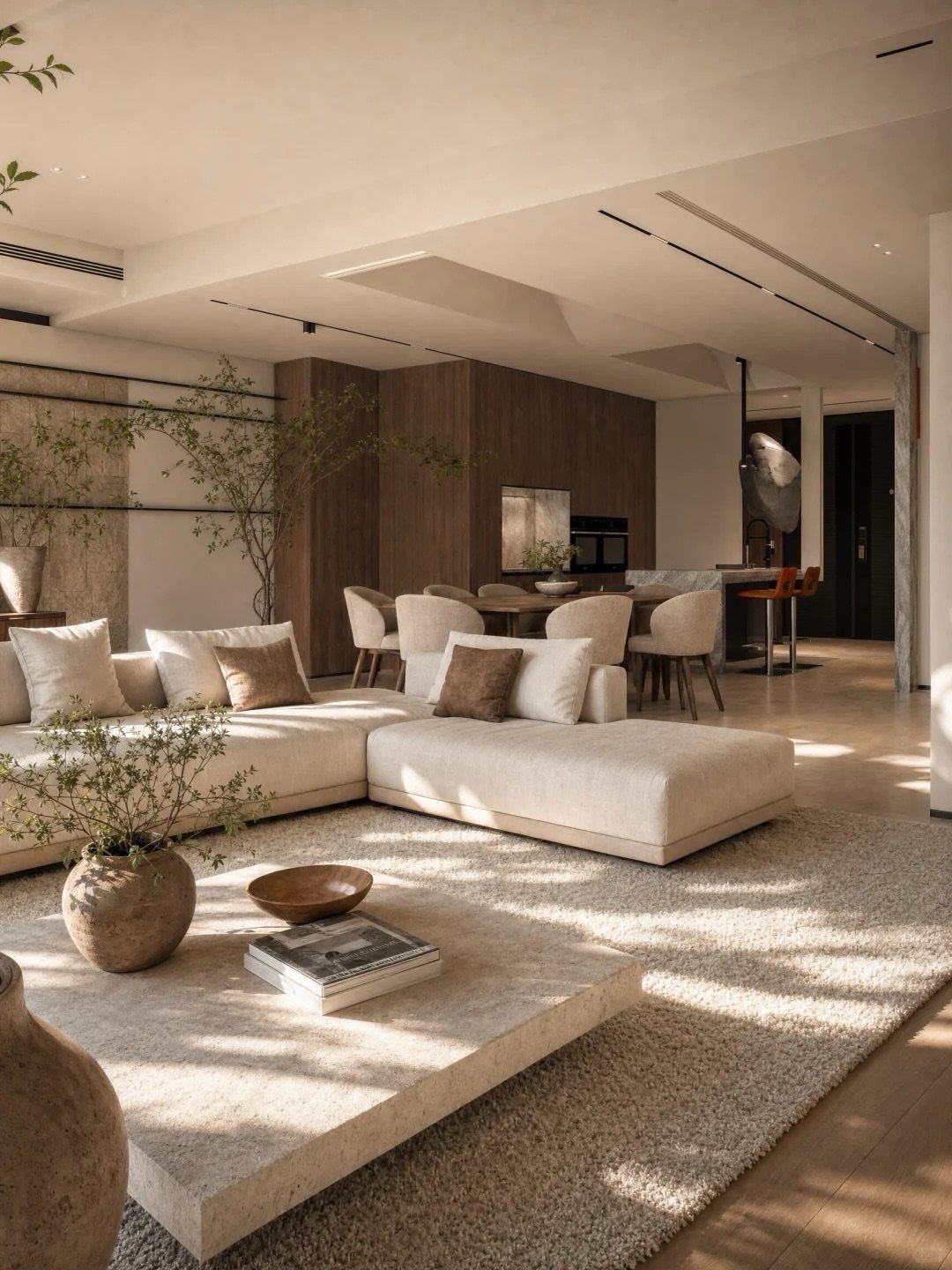
A travertine coffee table and a neutral rug keep the palette from going flat, because each material reads a slightly different shade.
Stay with 2–3 warm neutrals and let texture supply the contrast. Cool grays would fight the wood paneling, so hold a swatch against it before you buy.
2. Warm Lighting
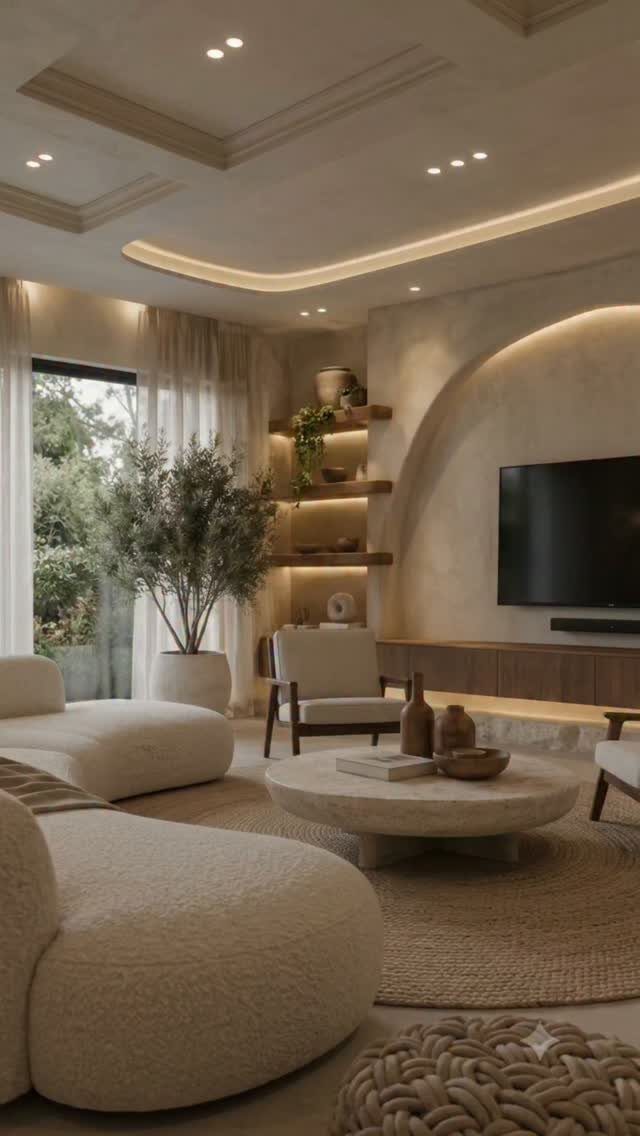
Hidden light does more for a room’s mood than any single lamp.
Renters can get close without cutting into anything: use warm-toned bulbs, and set lamps at different heights so the glow comes from several places. Sheer curtains help too, since they soften daylight in the same gentle way.
3. Statement Lighting
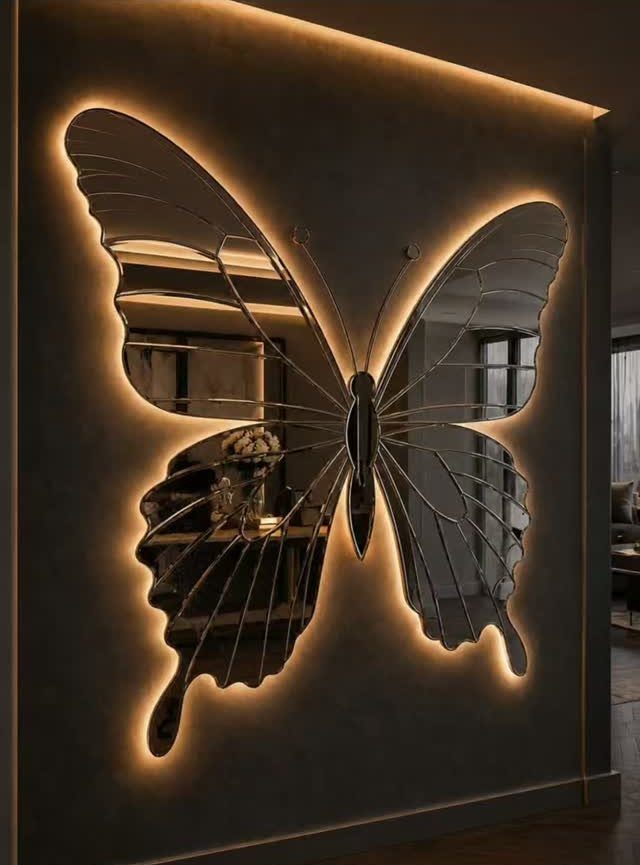
A backlit mirror counts as a light fixture, and I like it better than another pendant.
With one bold piece doing the talking, leave the rest of the wall bare.
4. Raw, Unpolished Finishes
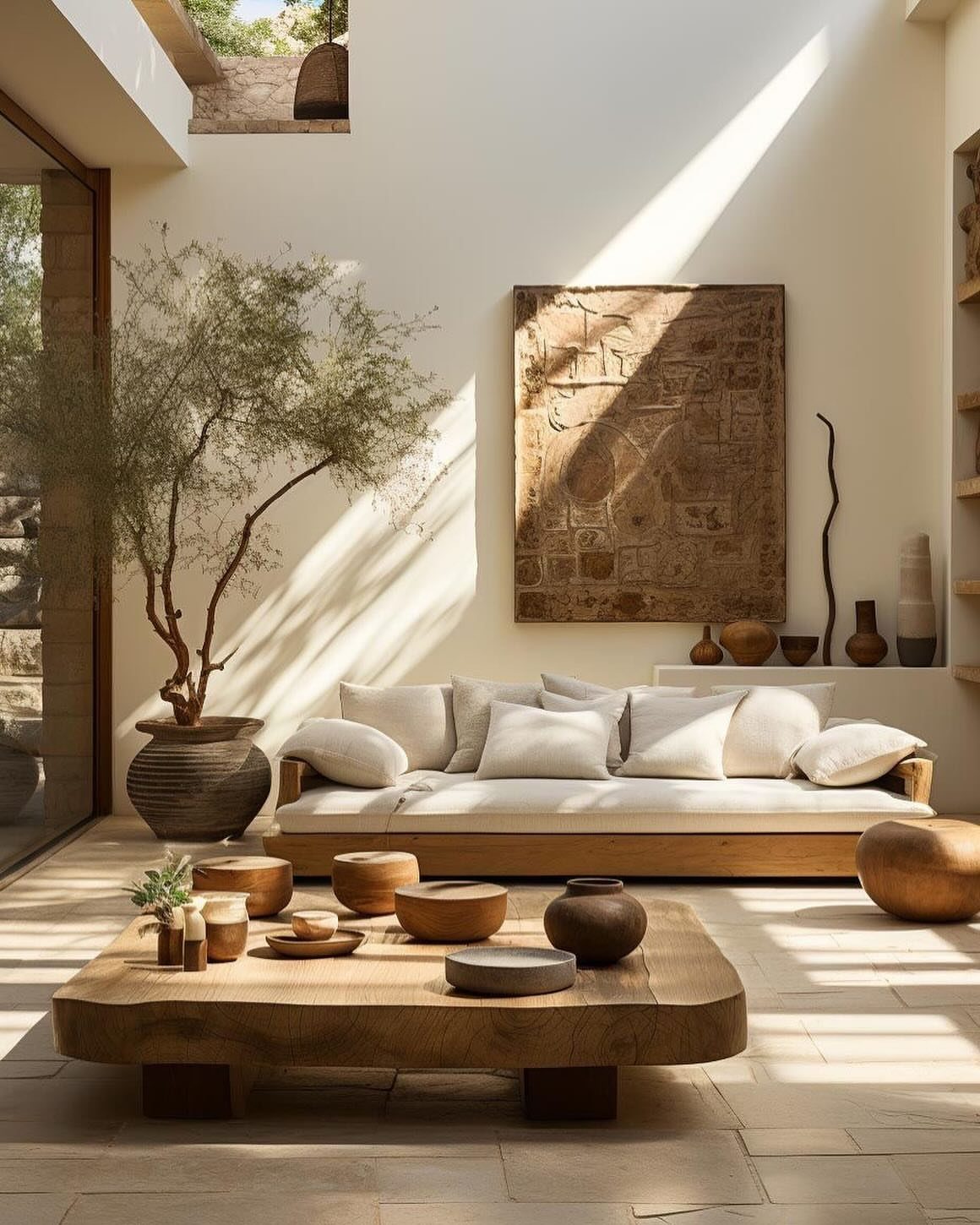
A low coffee table with a raw, uncut edge brings in the imperfection this style depends on. Its rough outline sits well against a clean white sofa, and a textured wall carving repeats the idea higher up.
Choose one or two unpolished pieces, not a whole room of them. Check the surface by hand before buying, because raw wood should feel good under a mug or a bare forearm.
5. Textured Wall Treatments
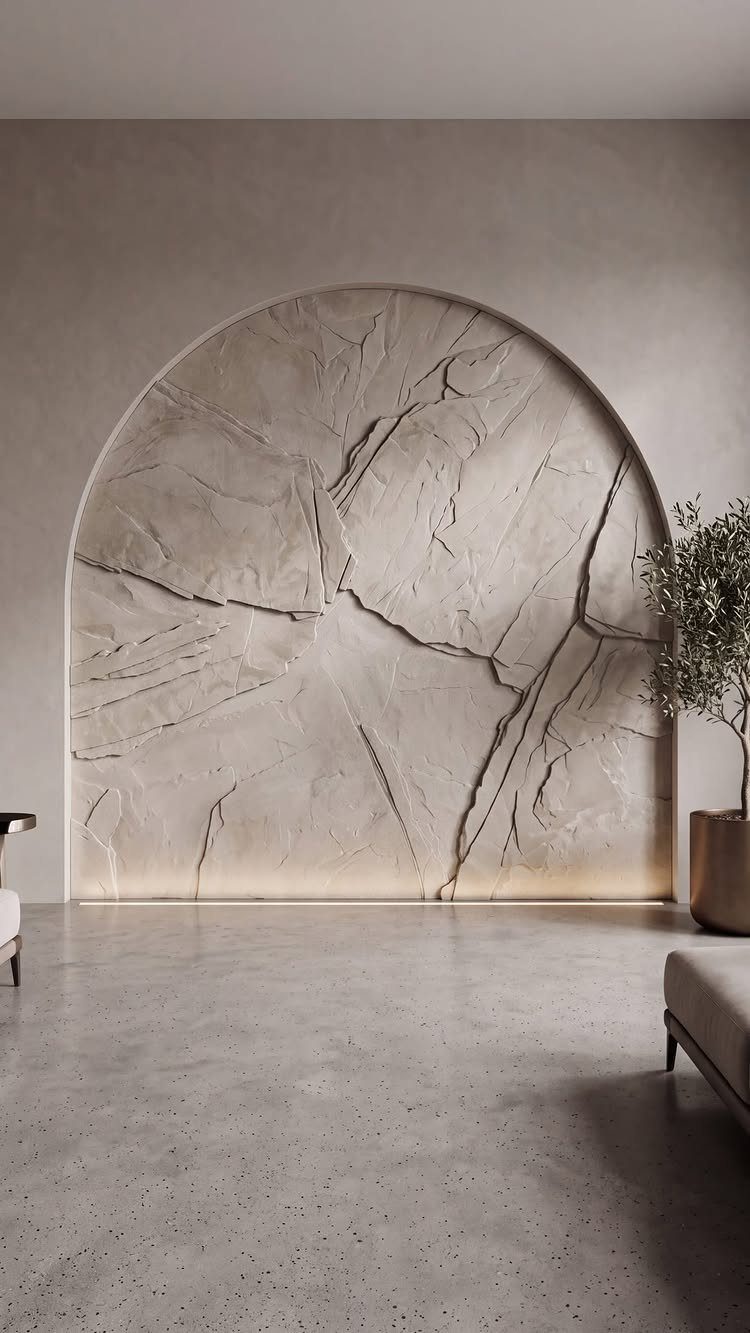
An arched plaster niche with a rough, carved-stone texture gives a plain wall real depth. Against concrete floors and a neutral sofa, the texture is the decoration, so nothing else needs to hang there.
Plaster finishes take patience and cost more than paint. For a weekend and a small budget, I would try a textured paint or joint-compound technique on a single wall, and test it on a board first.
6. Reclaimed Wood
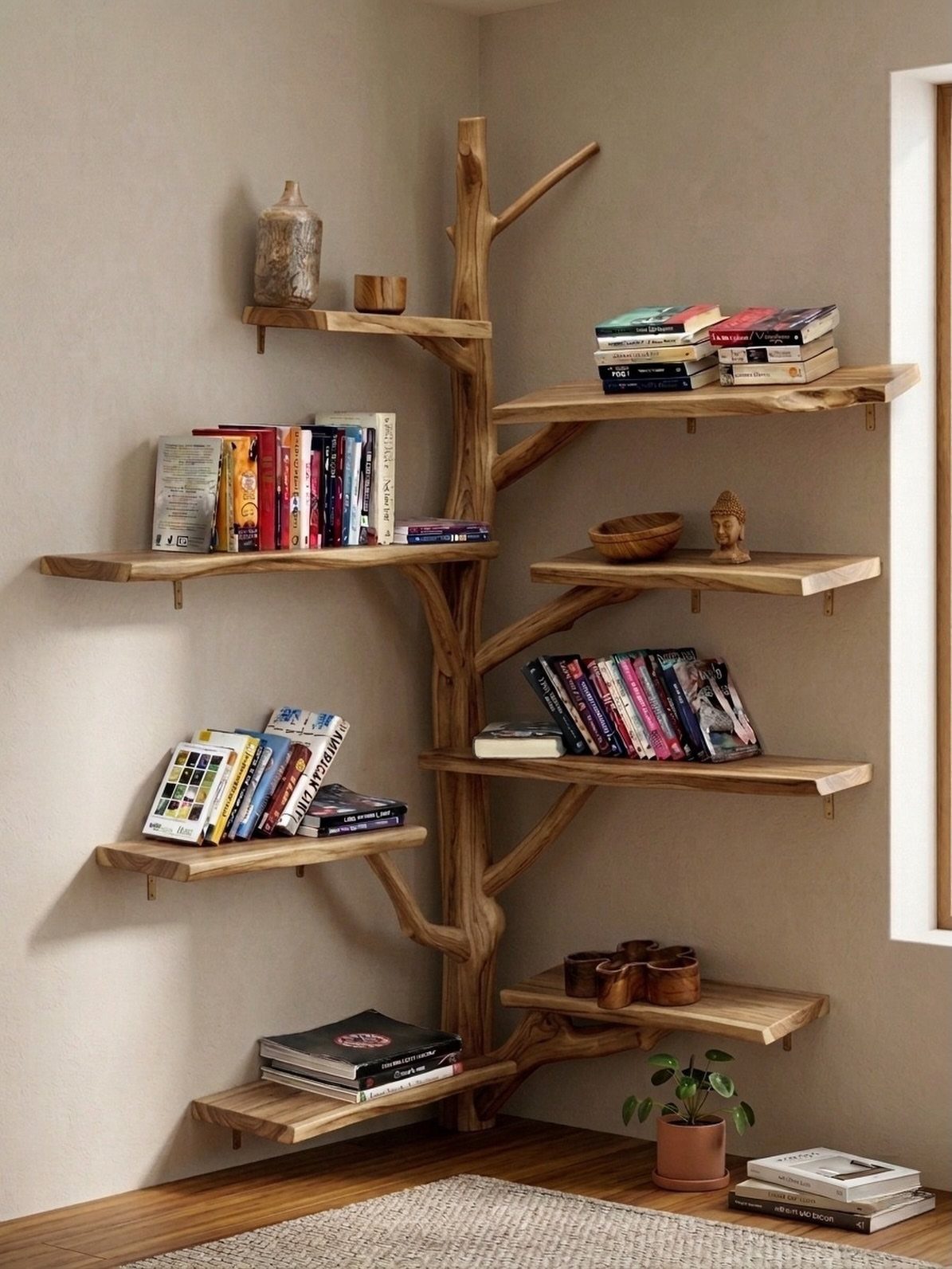
Mount it into studs, since a loaded shelf is heavy. Keep a plant on the floor beneath, and leave some shelf space empty so the wood shape still shows.
7. Sofas and Chairs with Soft Textiles
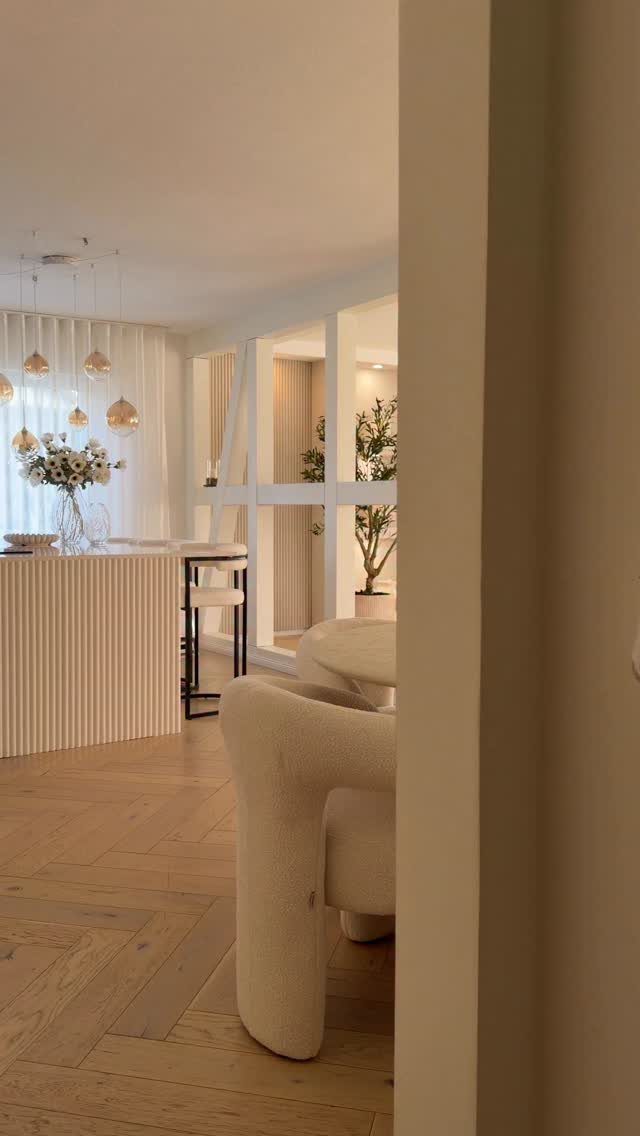
A curved bouclé armchair gives a room a soft edge that a boxy sofa can’t. The loops of the fabric catch light and add texture without any added color, so cream against pale herringbone floors stays calm.
Sit in a chair before buying it.
Bouclé should feel dense, not loose, because snagging is its weak spot. One curved chair is enough; keep the sofa plainer.
8. Minimalist Design
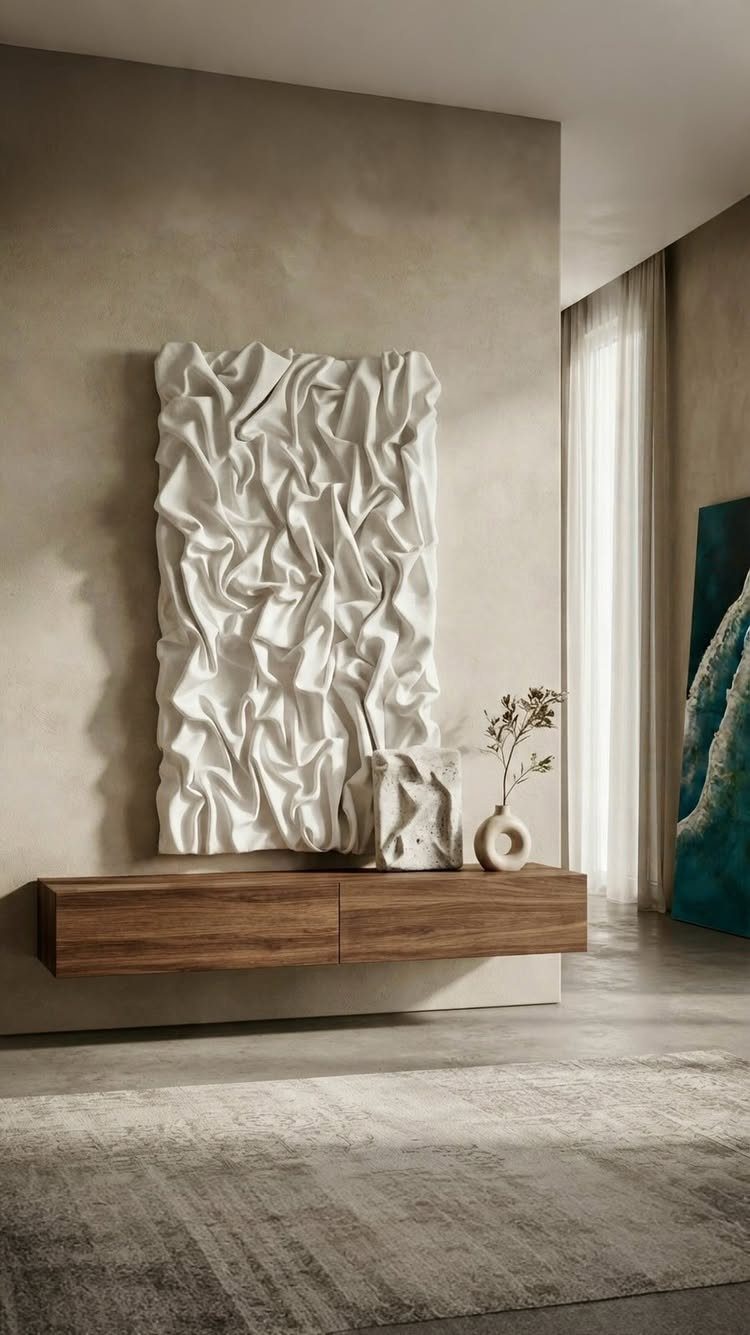
The texture does the work, so the console only needs a small vase with branches.
Leave the surface mostly bare. Add a single item at a time and stop when the wall still looks like the focus.
9. Pops of Earthy Colors
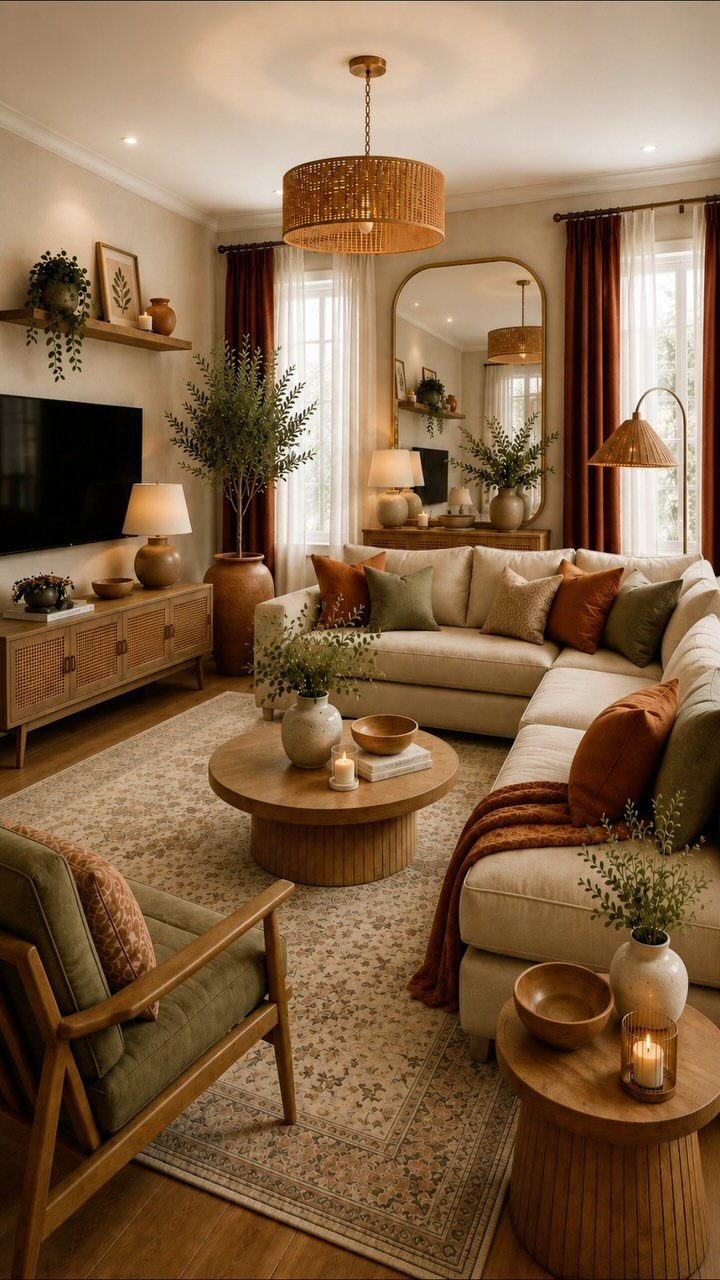
Terracotta curtains are the easiest way to bring earthy color into a cream room, because they cover a lot of area and cost less than replacing furniture. Green and orange pillows then pick up the same warmth in smaller doses.
Pick one main earth tone and one or two supporting ones. Anything beyond that starts to feel busy against a neutral sofa.
10. Sculptural Coffee Tables
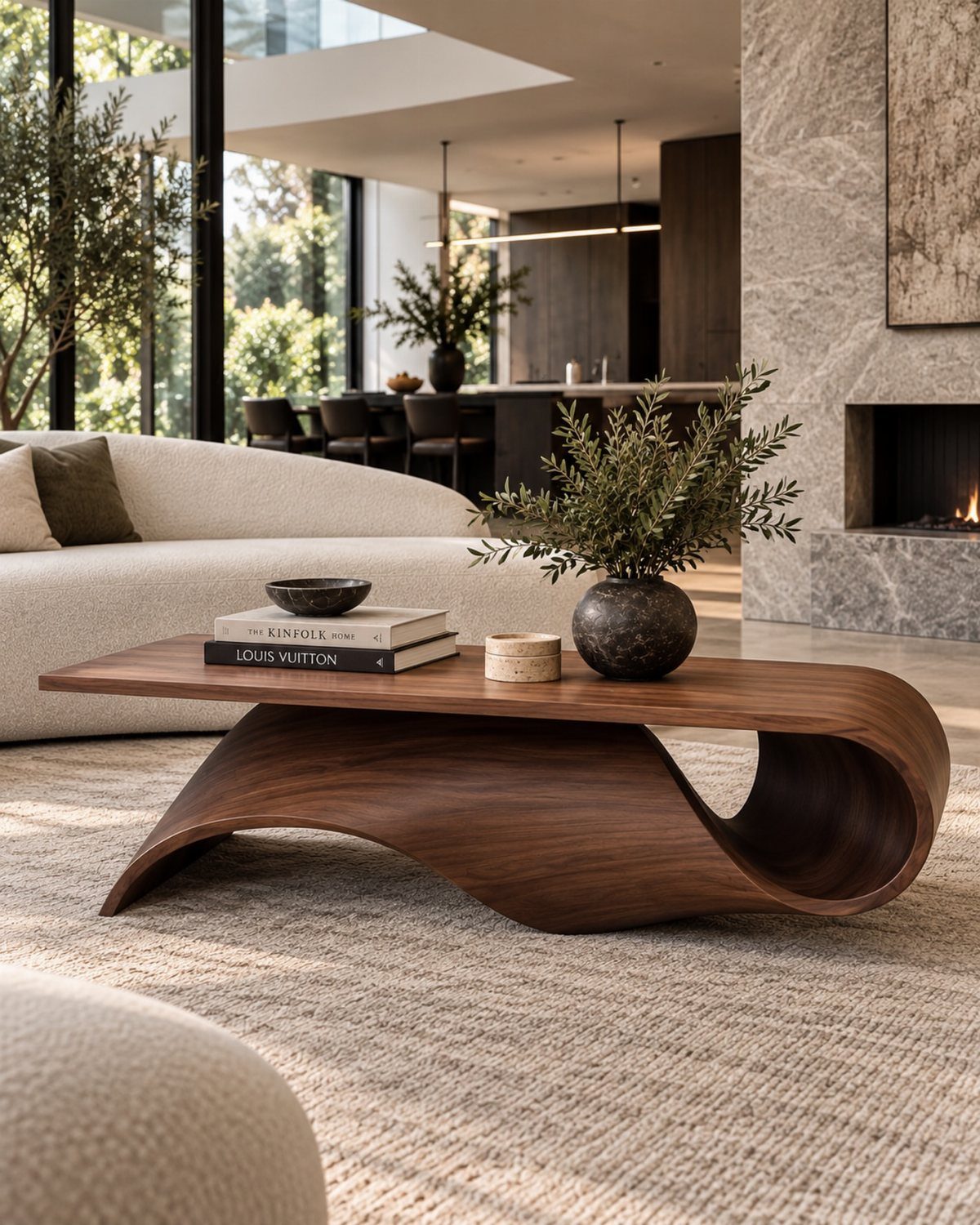
A curved walnut coffee table turns the center of the room into a sculpture, and the dark grain stands out against a neutral rug. With no sharp corners, it also makes walking around it easier in a tight space.
Keep the top simple. A short stack of books and one plant are plenty, since the shape is the point.
11. Floating Furniture Layout
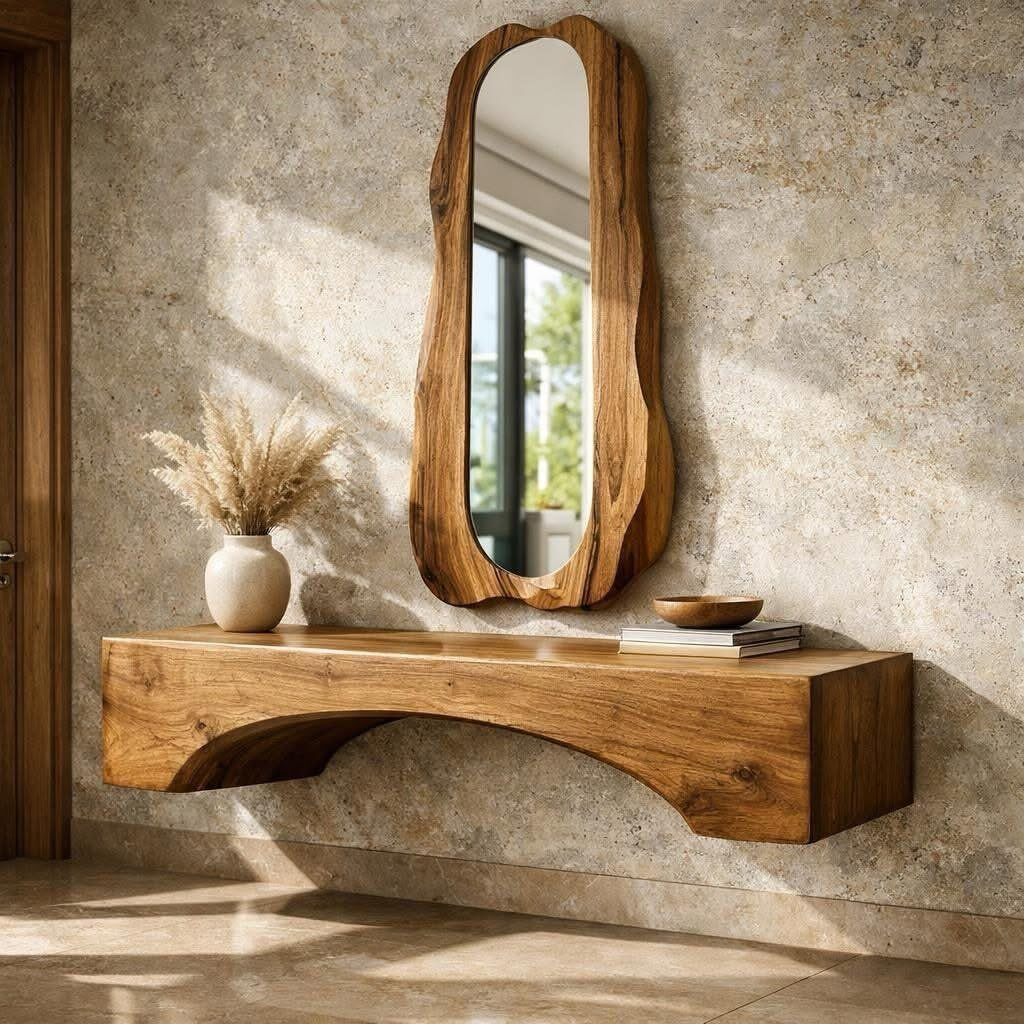
Lifting a console off the floor lets the wall and the floor show beneath it, which makes a room feel lighter. A live-edge top and an organic-shaped mirror above it repeat the same loose lines.
Mounting takes studs or proper anchors, so check what is behind the wall first.
Renters should ask about wall holes before drilling. Keep the styling to a vase and a small bowl.
12. Accent Side Tables
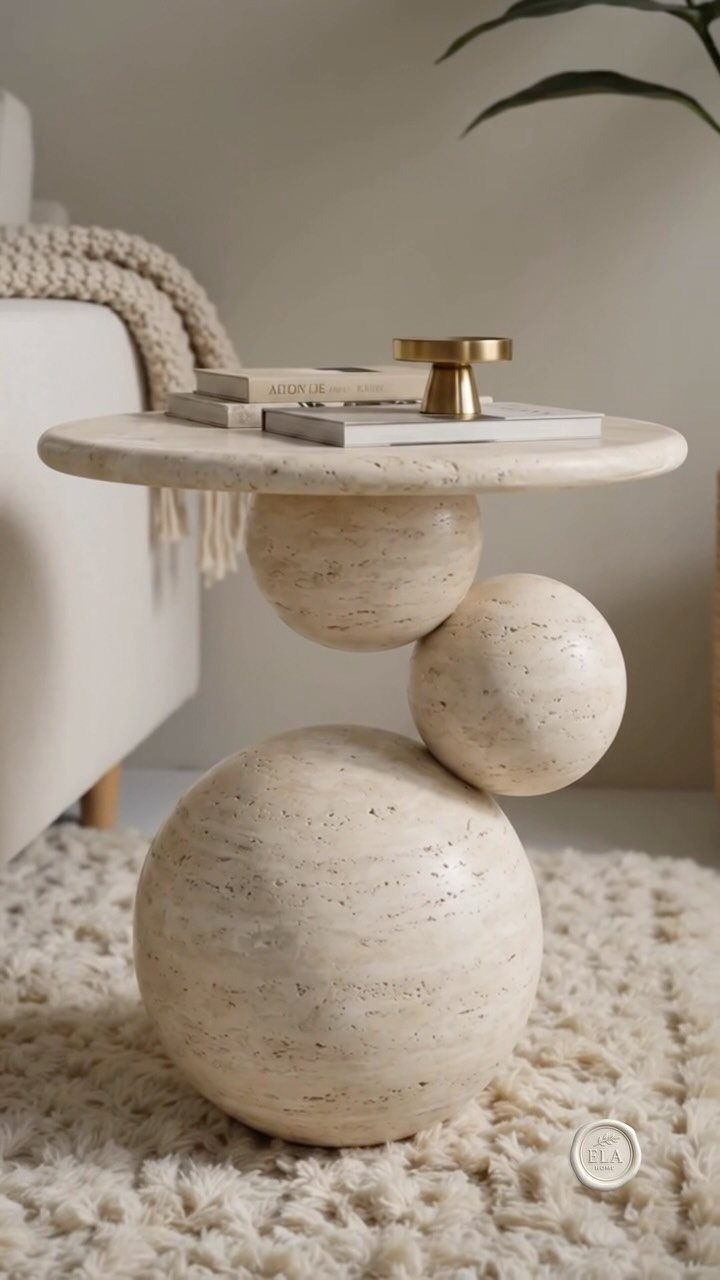
A travertine side table with a spherical base and top is a small piece that reads as sculpture. Next to pale upholstery on a shag rug, its stone surface gives the soft textures something solid to play against.
Choose one unusual table and keep the rest of the seating simple. Stone is heavy and can stain, so a coaster for drinks is worth the habit.
13. Wavy Sculptural Floor Mirror
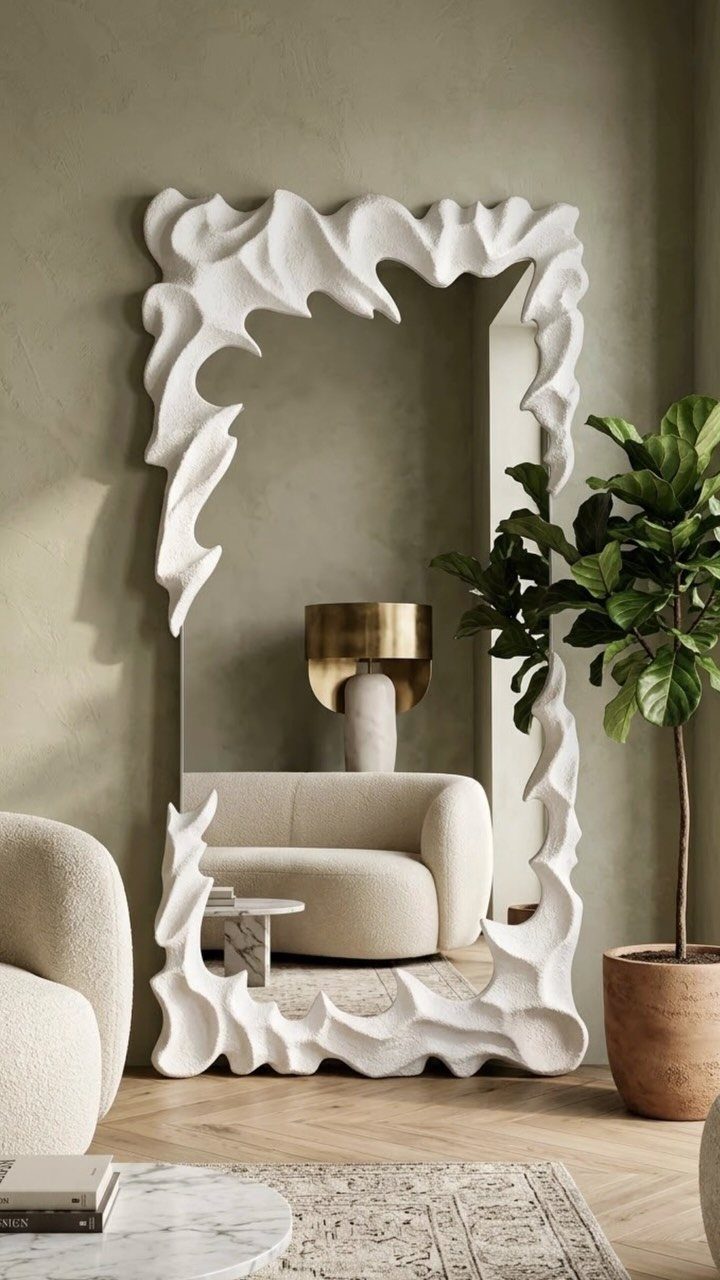
A full-length mirror with a wavy white frame works as a sculpture that happens to reflect the room. Leaned against the wall beside a curved sofa, its soft outline repeats the furniture’s lines.
Leaning needs no drilling, which suits renters.
Set it on a rug or add a felt pad under the base so it won’t slide on a hard floor. Put it where it bounces window light back into the room, and keep the wall around it bare.
14. Live-Edge Floating Shelves
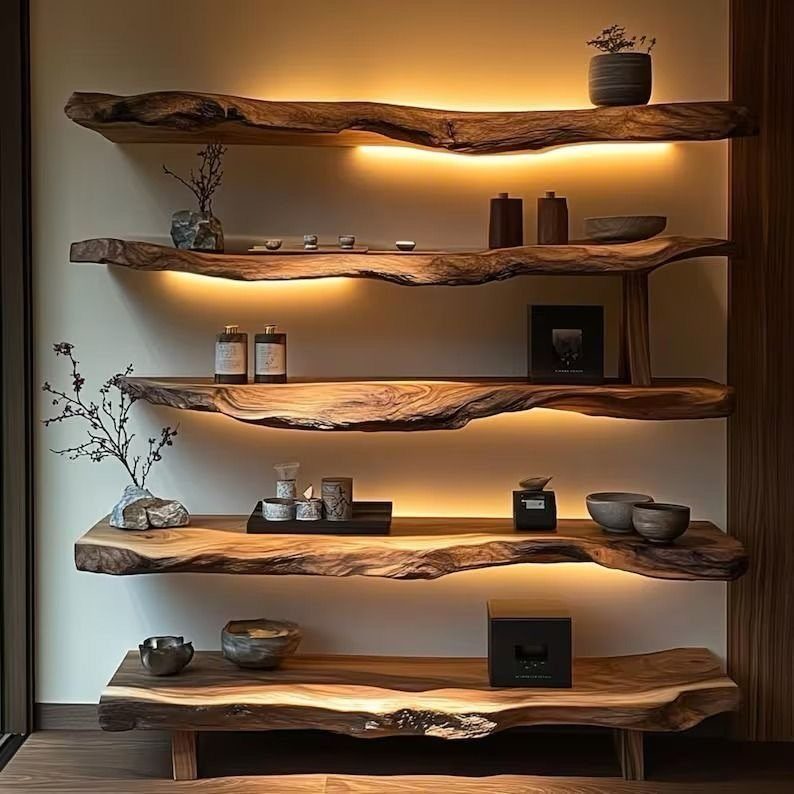
5 live-edge shelves stacked up a white wall turn plain storage into the main feature. Warm light tucked under each shelf makes the natural edge glow at night.
Mount into studs, and leave a few gaps between the ceramic bowls, vases and small plants so the wood still reads.
Stick with warm-toned bulbs or LED strips of 2700K–3000K under live-edge floating shelves, since cooler light turns the wood gray and flat while warm light brings out the grain.
Real slabs cost more than basic boards, so one or two shelves is a fair start.
15. Curved Organic Console Table
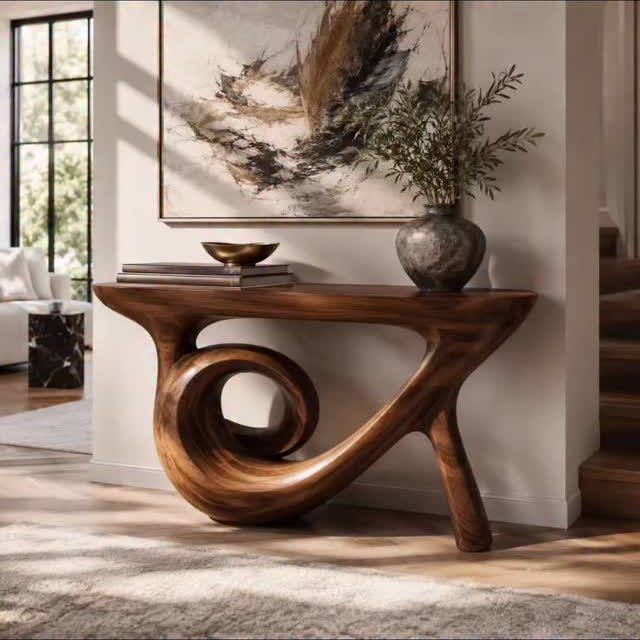
Soft, fluid curves in the base make this wooden console feel carved rather than built. The shape does the talking, so the styling can stay quiet: a few books, a bowl, and a vase of branches.
Stack the books low and let the branches add height. Skip a second large object, because abstract art above it already supplies one.
A neutral wall keeps the wood grain in front. I would pick this over a straight-legged console in a room with plenty of boxy furniture.
16. Natural Stone Floor Lamp
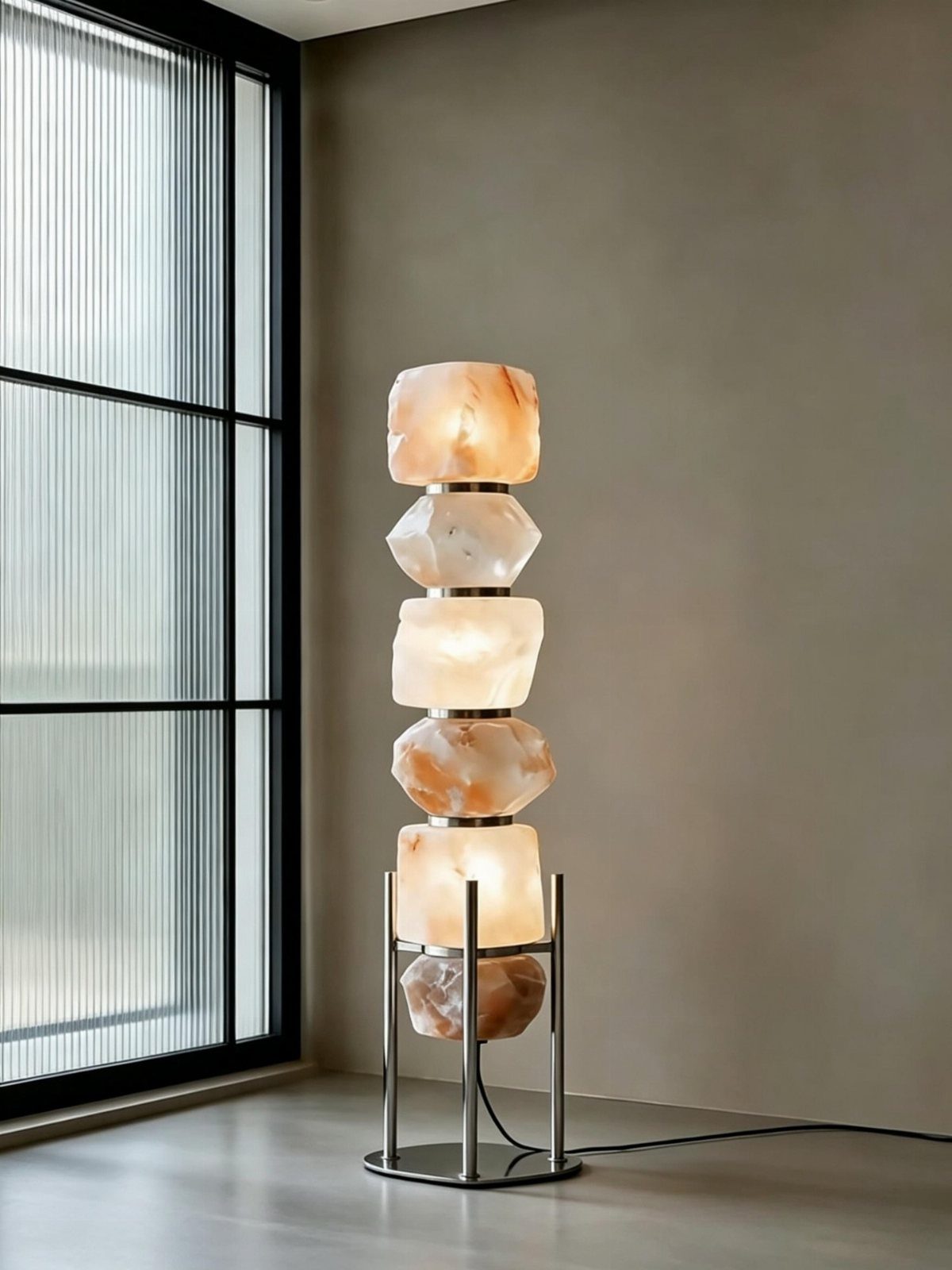
A floor lamp built from stacked raw mineral stones in a slim metal frame gives off a glow that looks lit from within. Beside a black-framed window, the rough stone and the clean metal make a pleasing contrast.
Give it a corner or window edge with open wall around it, since the lamp is the decoration. Check the light with the shade off the room’s other lamps: a warm, dim glow suits evenings best.
Expect a stone lamp to be heavy, so set it where it won’t be bumped.
Organic Modern Style Characteristics
Think of organic modern as minimalism with the chill taken off: wood, stone, linen and jute, cut into clean, plain shapes that look current. The room feels calm without feeling sparse.
3 principles hold it together: a minimalist foundation, natural finishes with organic silhouettes, and space left open on purpose so the room can breathe.
That last one is where many rooms slip. If every wall and surface is filled, the style stops working, however good the individual pieces are.
Furniture with hidden storage helps, since it keeps clutter out of sight and the floor open.
Before buying anything, ask whether the piece is simple in form and honest in material. If it is, it probably fits.
When it comes to interior design, “modern” and “organic” styles are not always mutually exclusive. In fact, some of the best spaces meld the two looks, resulting in clean-lines and a sense of warmth.
Importance of Natural Light
Daylight does the most for this style, so protect it. Keep the area around windows clear of bulky furniture, and skip heavy drapes that block the glass.
If your windows are tall or the ceiling is high, draw the eye up to them.
A paper lantern hung near the glass does this well, and soft, rounded furniture makes a good contrast to the sharp lines of big window frames.
Once the sun goes down, the lamps and accessories you choose decide whether the room still feels warm. Plan the evening light as carefully as the daytime light.
Balancing Elements
Balance here doesn’t mean an even split. A little tension between the modern and the organic makes the room more interesting than equal parts of each.
A workable rule is 70/30. Make about 70% of the room clean and streamlined: a track-arm sofa, a handleless media console, matte black steel hardware.
Use the other 30% for raw or textured pieces, such as a live-edge stool, an unpolished veined marble slab or a thick woven jute rug.
Don’t flip the ratio. A room that is mostly raw wood and textured wool loses its modern edge and turns heavy.
Set up the modern base first. A sleek room can pick up texture with a few additions, but a space packed with rustic timber is much harder to tidy up with modern lines.
Frequently Asked Questions
Is organic modern still in style?
Yes, it remains a popular and enduring approach. It lasts because the form stays simple and the warmth comes from real materials like wood and stone, so a room built this way doesn’t depend on a passing color or gimmick.
Keeping surfaces open and the palette to 2–3 warm neutrals helps it stay current.
What is the 3-5-7 rule in decorating?
It’s a guideline that calls for 3 colors, 5 textures and 7 materials in a space.
It fits organic modern loosely, since this style leans on texture more than color: stick to 2–3 warm neutrals and let wood, stone, bouclé and jute supply the contrast.
The rule is a starting point, and a room that gets too full loses the calm.





